
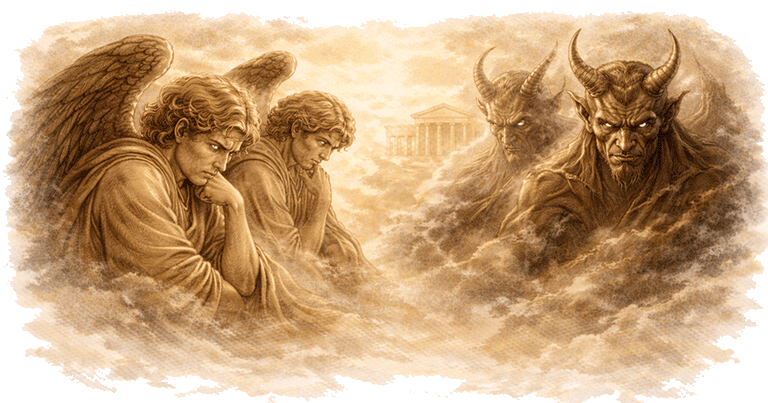
In much of modern Christian thought, the terms fallen angels and demons are used interchangeably. The assumption is simple: demons are angels who rebelled against God and were cast down. While this explanation is familiar and rhetorically tidy, it is neither stated explicitly in Scripture nor representative of how the biblical world was originally understood.
When the Bible is read within its ancient Jewish context, particularly the worldview shared by Second Temple Judaism and the New Testament writers, a more nuanced and coherent picture emerges. Fallen angels and demons are not the same beings. They arise from different rebellions, possess different characteristics, and are subject to different judgments. This older framework is consistent across biblical and early Jewish literature and proves far more explanatory than later theological simplifications.
Fallen Angels: A Heavenly Rebellion and Immediate Restraint
Scripture clearly affirms the existence of angels who rebelled against God. These beings are portrayed as members of the heavenly host who violated their appointed role or domain. The earliest narrative foundation appears in Genesis 6:1-4, where the “sons of God” transgress the boundary between heaven and earth. Later biblical authors treat this episode as a grave and decisive rebellion rather than a peripheral myth.
Second Peter states that angels who sinned were cast into Tartarus and committed to chains of darkness, being held for judgment (2 Peter 2:4). Jude echoes this language, describing angels who “did not keep their own domain” and are now kept in eternal bonds (Jude 6). Revelation further depicts a heavenly rebellion led by Satan, resulting in expulsion from the heavenly realm (Revelation 12:3-9).
Across these passages, one feature is consistent: fallen angels are restrained. They are not depicted as freely roaming among humanity. Their rebellion results in confinement, not continued activity. Scripture presents fallen angels as a category of beings whose transgression was so severe that immediate restraint was required.
Demons: Active, Earthbound, and Restless
Demons, by contrast, are portrayed quite differently. In the Gospels, demons are numerous, mobile, and intensely focused on human beings. They seek embodiment, resist expulsion, and express fear not of destruction, but of confinement. In Luke 8, demons beg Jesus not to send them into the Abyss (Luke 8:31). In Matthew 8, they ask whether He has come to torment them “before the time” (Matthew 8:29).
These details are significant. Demons are not portrayed as imprisoned rebels awaiting judgment, but as restless spirits operating in the earthly realm, fully aware that their activity is temporary and their judgment inevitable. Notably, the New Testament never explicitly identifies demons as angels.
Second Temple Jewish Literature: The Missing Context
This distinction was not obscure to ancient readers. Jewish literature from the Second Temple period, written centuries before the New Testament, provides the interpretive framework the biblical authors assumed rather than explained.
The most influential of these texts is 1 Enoch. In 1 Enoch 15:8–12, the giants (Nephilim), born from the forbidden union of angelic beings and human women described in Genesis 6, are destroyed in the Flood. Their bodies perish, but their spirits survive. Because they are neither fully angelic nor fully human, they are denied access to heaven and denied rest among the human dead. These disembodied spirits remain on the earth as malevolent forces afflicting humanity and are explicitly identified as “evil spirits” (1 Enoch 15:8-12).
The book of Jubilees reinforces this understanding. Jubilees 10 describes the spirits of the giants corrupting Noah’s descendants after the Flood. Noah prays for relief, and God responds by binding most of these spirits, while allowing a limited number to remain under strict restraint (Jubilees 10:1-11). This passage explains not only the persistence of demonic activity but also its limitation and eventual judgment.
These writings do not invent a foreign mythology. Rather, they preserve an interpretive tradition that explains what the biblical text itself implies but does not formally systematize.
Biblical Language That Preserves Theological Memory
The Hebrew Bible itself subtly reflects this framework through its use of language. The term Rephaim refers both to ancient giant clans encountered by Israel (cf. Deuteronomy 2-3) and to the “shades” or departed dead in poetic and prophetic texts (Isaiah 14:9; Isaiah 26:14; Psalm 88:10). This overlap suggests theological memory: the mighty ones of old are remembered not only historically, but spiritually.
Such language is difficult to account for if demons are simply fallen angels. It aligns naturally, however, with the idea that demonic beings are the lingering spirits of a corrupted pre-Flood order.
The Limits of the Modern Collapsed Model
The tendency to equate demons with fallen angels developed gradually in later Christian theology, particularly after Augustine. While philosophically simple, this collapsed model struggles to explain why demons seek embodiment, why they fear confinement, why some rebellious beings are already imprisoned while others roam freely, and why Scripture consistently treats their judgment differently.
By contrast, the ancient framework resolves these tensions organically. Fallen angels are restrained because their rebellion was cosmic and structural. Demons remain active because they are earthbound remnants of a corruption God has allowed to persist temporarily within limits.
Conclusion: Restoring Clarity Through Distinction
Fallen angels and demons are not interchangeable labels for the same beings. They arise from different acts of rebellion, occupy different roles in the biblical narrative, and face different judgments. Fallen angels rebelled from heaven and were confined. Demons are the restless, disembodied spirits of a pre-Flood corruption, active for a time but destined for final judgment.
Recovering this ancient distinction does not complicate Scripture, it clarifies it. It restores coherence to biblical cosmology, depth to spiritual warfare, and continuity to the story that runs from the corruption of Genesis 6 to the final judgment described in Revelation. In doing so, it reminds modern readers that the Bible’s worldview is not simplistic, but profoundly ordered, intentional, and complete.
Bibliography
The Holy Bible, English Standard Version. Crossway, 2016.
1 Enoch. Translated by R. H. Charles. In The Apocrypha and Pseudepigrapha of the Old Testament, Vol. 2. Oxford: Clarendon Press, 1913.
Jubilees. Translated by James C. VanderKam. In The Old Testament Pseudepigrapha, Vol. 2. Edited by James H. Charlesworth. New York: Doubleday, 1985.
Heiser, Michael S. The Unseen Realm: Recovering the Supernatural Worldview of the Bible. Bellingham, WA: Lexham Press, 2015.
Heiser, Michael S. Demons: What the Bible Really Says About the Powers of Darkness. Bellingham, WA: Lexham Press, 2020.
Bauckham, Richard. Jude, 2 Peter. Word Biblical Commentary, Vol. 50. Dallas: Word Books, 1983.
Walton, John H. Ancient Near Eastern Thought and the Old Testament. Grand Rapids: Baker Academic, 2006.